Archive

Archive for the ‘Mosquito Control’ Category

Use a Mosquito Trap at your Outdoor Wedding and say “I Don’t” to Mosquitoes

March 21st, 2012 No comments

                                                                                           (photo: Sarah-lee ‘Oto)

Summer;  it’s a popular time for weddings and mosquitoes.  And while Winston Churchill probably wasn’t the first person you thought of when you got engaged; he knew a thing or two when he said “He who fails to plan is planning to fail”.

Attract, Trap, ENJOY!
The one thing you do need to plan for with a summer wedding, especially if it’s going to be outdoors, is mosquitoes.  To help create a ‘no-fly zone’ at your outdoor venue, consider a mosquito trap – they work by attracting, trapping, then killing mosquitoes. 

Most mosquito traps are designed to catch immediately there are any mosquitoes around however, should be set up at least 2-3 weeks in advance of the big day. That’s because it typically takes that amount of time to disrupt breeding cycles and reduce mosquito populations. This will help decrease the risk of getting bitten as well as the possibility of getting sick from the many diseases mosquitoes carry.  

Cost, coverage area and guest safety are all important factors when deciding which brand to use.  Eco-friendly, Mega-Catch™ mosquito traps don’t use pesticides or propane, instead these multi attractant traps mimic the smell and sight of prey, fooling mosquitoes into sensing a blood meal close at hand. When they get near, powerful fans sweep them into the trap’s catch container where they eventually die. 

Source Reduction
Make sure that there are no areas of ‘standing water’ where mosquitoes can breed.  Birdbaths, buckets, wheelbarrows, pot plant saucers – anything that holds water is a potential mosquito nursery.

Repel
Mosquito repellents should be regarded as staple for any outdoor event.  However while repellents provide excellent personal protection, they don’t actually kill mosquitoes.  That’s why you need mosquito traps. Read more…

Mosquitoes Prefer Mega-Catch™ Mosquito Traps

October 30th, 2010 1 comment

Scientifically and independently tested around the world, Mega-Catch™ mosquito traps have consistently outperformed other brands.

Sparked by the emergence of diseases in the U.S. like West Nile Virus and Dengue, consumer demand for mosquito control devices has increased along with the number of companies manufacturing mosquito traps.  Mega-Catch™ mosquito traps have some impressive customer feedback, but even more convincing are the test results.

Mega-Catch™ in Malaysia

Mega-Catch™ mosquito traps were developed after an extensive worldwide testing program.  In early 2000 Professor Yap Han Heng from the Vector Control Research Unit, School of Biological Sciences, University Sains Malaysia was engaged to advise on and test Mega-Catch™ trap designs in South East Asia. One of the primary objectives was to develop a trap which would attract and capture the Asian tiger mosquito (Aedes albopictus), a voracious daytime biter and vector of over 30 arboviruses including West Nile Virus (WNV) and Dengue fever.  Tests carried out in a reserve forest at Minden Campus, University Sains Malaysia in the Penang Island led Professor Yap Heng to conclude that Mega-Catch™ was effective against the Asian tiger mosquito in outdoor  conditions in tropical environments.

Mega-Catch™ in the U.S.

1.Mega-Catch™ out-catches Mosquito Magnet® Pro and Mosquito Magnet® Residential

In 2001 the Mega-Catch™ ULTRA and Mosquito Magnet® Pro and Residential traps were put to the test in central Florida by USDA research entomologist Dr Daniel Kline.  The test was conducted over about three weeks at three different locations; a laboratory, a yard in a residential neighborhood and in a wildlife refuge. The catch varied by location, but the overall result was that the Mega-Catch™ trap captured about twice the number of Aedes aegypti – the yellow fever mosquito – and a larger general variety of other mosquitoes than did the Mosquito Magnet®. Read more…

Mosquito Bites 101 – How to survive the itch

August 10th, 2010 1 comment

Mosquitoes = Misery.  Few insects can ruin a pleasant evening outdoors as quickly or completely as mosquitoes.  First, that incessant whine, the prelude to an attack, sets in around your ears. Then, you start to feel the hot pinprick of mosquito bites at ankle and arm, one after another, until the itch sets in and you can’t take any more.

It’s enough to send you storming inside.  And the worst part is that mosquito bites just don’t disappear immediately and you’re left with ugly red bumps that swell and itch, no matter how fiercely you scratch (and you know you shouldn’t), for the rest of the night.

The way mosquito experts tell it, these pests have been a plague on man since Jurassic times and to date we still haven’t found a way to completely rid ourselves of them or their annoying bites.

However, there are things you can do to prevent mosquito bites and treat the allergic Read more…

Categories: Misc, Mosquito Control

Mosquito Traps Form Part Of An Effective Mosquito Control Program

March 31st, 2010 No comments

Not every kind of mosquito carries every kind of disease, however a single bite from the right mosquito at the right time, and you’re infected.  Prevention…the best protection!  Because according to University of Florida entomologist Jerry Butler, “By reducing the feeding rates just a little, you reduce the probability of transmission of diseases greatly“. 

Mosquitoes love to feed on humans, and selecting their next meal is relatively easy for these high tech hunters with compound eyes capable of spotting the slightest movements and receptors so sensitive, they can detect the smell of CO2 in a person’s breath from as far away as 400 meters.  Lucky for us, those same abilities also tend to lead them straight into mosquito traps. Read more…

Mosquito Bites 101 – Prevention and Treatment

November 18th, 2009 No comments

Find out how to treat the bite as well as what  to do to reduce the number of biting incidences and the risk of mosquito-borne diseases for you and your family.

Mosquito-Bites-101-Web

PREVENTION:

Start by devising an effective DIY mosquito control program which incorporates a proven trapping system to reduce mosquito numbers, personal protection in the form of repellents, and a proactive approach to reducing and eliminating mosquito breeding sites around your property.

Elimination
The first step in reducing mosquitoes on your property is to identify and eliminate all sources of standing water including low spots, ditches, and gutters. 

Mosquitoes will breed in anything that holds water, including many everyday items such as a child’s toy, plant saucers, buckets, garbage can lids and pet food dishes.  All easily overlooked items!  

During the day, mosquitoes love to rest in tall grass or amongst shrubs in a moist, shady spot. Keeping the grass short and bushes trimmed deprives them of a resting place. Rake up any fallen leaves as well.   An overturned leaf can hold enough water for a mosquito’s eggs, as well as give them a place to wait out the day.

Trapping
Let science help solve your mosquito problems.  Today’s mosquito traps are smaller, more effective and surprisingly affordable!  A consumer favorite, the Mega Catch™ Ultra has outperformed many competing traps in independent tests, thanks to its unique, propane-free, CO2 system.   Combining proven mosquito-attracting science in a simple to operate, user friendly design the Ultra gives coverage of up to 1.5 acres and is designed to operate with or without Mega-Catch’s™ patented ‘Variable Quantity Slow CO2 Gas Release System’. 

The optional CO2 system has been designed to enhance trap performance by increasing the range and capture rates (by as much as 300-400%) of a wider variety of mosquito species and other biting insects.
                    
Repellents
Bear in mind that repellents do not protect all users equally. The effectiveness of a repellent depends on the mosquito species that is biting as well as the age, sex, level of activity, and attractiveness (to mosquitoes that is) of the human using the repellent.

In general, mosquito repellents work by masking the chemical cues that invite mosquitoes to dine.  Read more…

Categories: Mosquito Control

Winter DIY Mosquito Control

October 27th, 2009 No comments

Q.  If they don’t fly south for the winter, where do mosquitoes go?

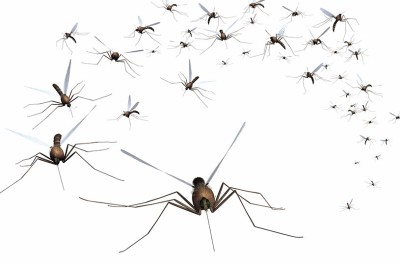
swarm of mosquitoesA. Mosquitoes, like all insects, are cold-blooded creatures. As a result, they are incapable of regulating body heat and their temperature is dependent upon their surroundings. Mosquitoes are known to function best at 80o F, become lethargic at 60o F and cannot  function below 50o F.  Not all mosquitoes die from the cold and over-winter in various guises: 

  • Some species of mosquitoes overwinter as adult females in a state of diapause (a hibernation-like state of arrested development), hiding out in barns, tree holes, basements, attics, etc. anywhere they can get out of the wind. 
    Typically, the female mosquito mates before the onset of winter, refusing to take a blood meal, instead feeding only on sugar.  Their ovaries stop working, so their eggs will not mature.  And they store plenty of fat to sustain them over winter. In spring when the temperatures rise, the female emerges from hibernation, seeks out a blood meal and lays the eggs that produce the next generation of adults.
  • Certain mosquito species lay winter hardy eggs able to survive extreme weather, such as cold, ice, and drought.  Typically in late summer or fall, the female lays her eggs in areas where the ground is moist.  In spring, when temperatures begin to rise and moisture is produced by spring rains and melting snow and ice, these eggs will hatch, progressing through larval, pupal, and finally adult stages to begin the cycle all over again.
  • And other species of mosquitoes can survive winter in the larval stage.  All mosquito larvae require water, even in winter.  As the water temperature drops, it induces a state of diapause in the mosquito larvae. Development only resumes when the water warms up again.

Winter Mosquito Control
Winter is a great time to institute some DIY home mosquito control.  We all know mosquitoes need still, stagnant water to breed.   Read more…

The Cat N the Mosquito Trap

October 21st, 2009 No comments

Kitten-and-trap
Mosquitoes love your family and your pets
.  In addition to being a nuisance, mosquitoes are known to transmit diseases such as West Nile virus and Heartworm in cats and dogs.

The FDA has traditionally advised keeping your pet indoors around dawn and dusk, because that’s when many mosquito species feed. However that advice is no longer enough to protect your pet. The Asian Tiger mosquito (Aedes albopictus) is an aggressive daytime biter and it carries both West Nile virus and heartworm parasites.  So each time your pet is outside in mosquito territory, it is a sitting target for hungry female mosquitoes seeking a blood meal. 

West Nile virus along with the age-old, ever adaptable mosquito, is probably here to stay so ongoing precautions are essential.  The same thing that protects you against mosquito diseases also protects your pets. Prevention! 

  • Eliminate breeding sites
  • Use mosquito repellents, and
  • Decrease exposure

Eliminate Breeding Sites
Change the water in birdbaths and paddling pools weekly and clean debris from rain gutters.  Eliminating standing water and long grasses will also help create an inhospitable environment for mosquitoes, encouraging them to go elsewhere

Repellents for Pets
There are a number of mosquito repellents available for pets, however as no repellent is 100% effective, heartworm preventatives should still be used.  When choosing a mosquito repellent for your cat or dog, bear in mind that certain chemicals may be harmful or even fatal to your pets.  Human repellents containing DEET have been known to poison cats and should never be used on them. Read more…

Mosquito Control 101: Don’t be a mosquito attractant this summer

June 29th, 2009 No comments

Ants at a picnic? They just want everything on the menu. For mosquitoes, you are the menu.  And if skeeters have a favorite time of the year, it’s summer break, all those bare arms and legs slowly marinating in suntan oil. Let the ants have the potato salad; the mosquitoes want sushi!

Mosquitoes use their antenna to seek out hot targets putting out carbon dioxide (CO2) the stuff we exhale.  If you’re huffing and puffing around the back yard, playing with the kids or flipping burgers on the grill, you’re especially appealing.  So if you want off the mosquito radar, hold your breath or find them a meal replacement – more on that later!

Read more…

Categories: Mosquito Control